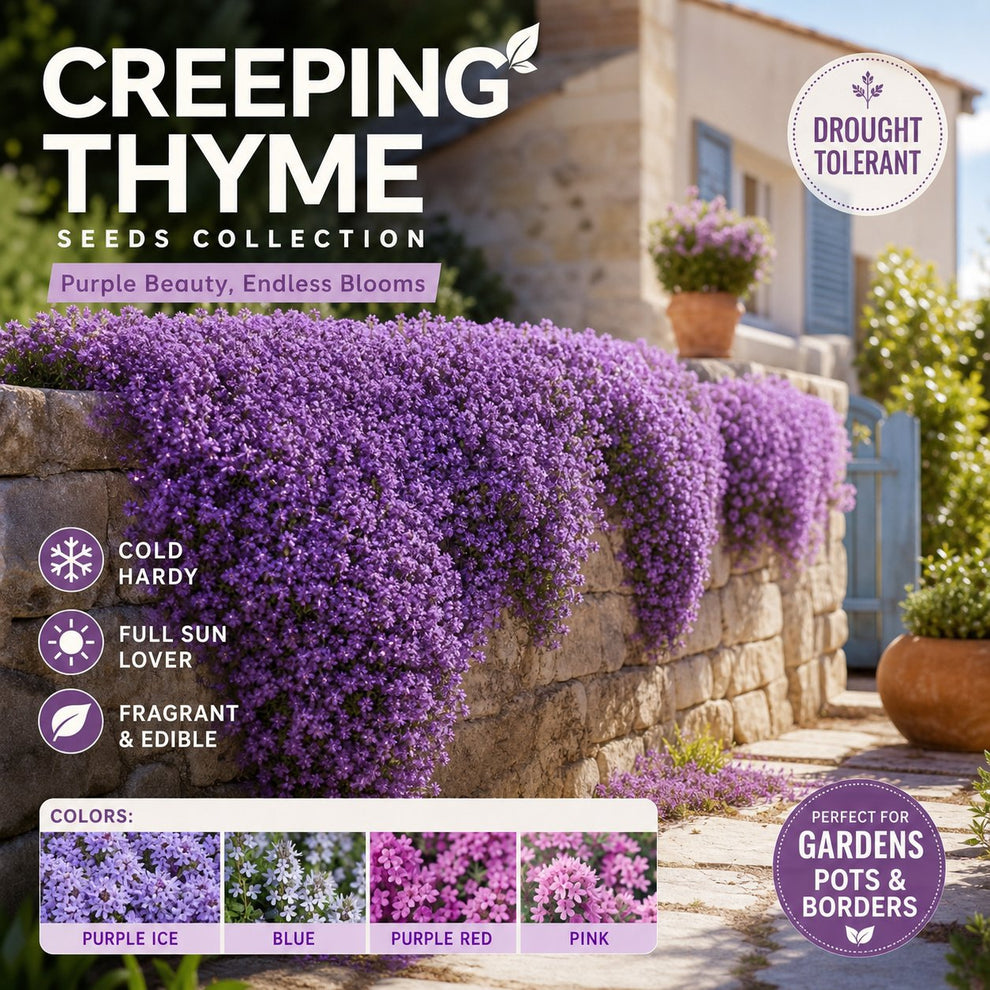
🌿 CREEPING THYME SEEDS
Turn the Empty Parts of Your Garden Into Living Color.
A low-growing flowering groundcover that can soften stone, fill garden edges and add waves of purple color where ordinary bare soil once showed through.
🌸 Purple Blooms 🌿 Groundcover Habit 🪨 Great Around Stone
🌸
Colorful Coverage Tiny blooms can create a broad carpet of color.
🪨
Loves Garden Edges Beautiful around rocks, borders and paving.
☀️
Sunny-Garden Appeal A natural choice for bright outdoor spaces.
🌱
Grow From Seed Start small and gradually build your planting
.
THE FIRST REASON TO GROW IT
Bare Stone Can Become Part of the Garden.
Instead of leaving walls and edges visually empty, creeping thyme can soften hard landscaping with low foliage and seasonal flowers.
WHEN IT FILLS IN, THIS IS THE LOOK
A Low Carpet of Tiny Purple Blooms
The appeal is in the scale: hundreds of tiny flowers gathering into one soft, colorful groundcover effect.
ONE PLANTING STYLE • MANY PLACES TO USE IT
Give the Awkward Spaces Something Beautiful to Do.
Use creeping thyme where low-growing coverage works better than another upright garden plant.
🪨
Stone Walls Let the planting soften hard wall edges.
◇
Pathways Add color around paving and stepping stones.
▣
Planters Use at the edge for a softer trailing look.
🌿
Garden Borders Create a colorful transition into lawns and beds.
ESPECIALLY GOOD AROUND STONE
Rock Gardens Don't Need to Look Hard & Bare.
Low-growing foliage naturally suits spaces around stones, retaining walls and sloped garden areas where taller plants may feel out of place.
SOFTEN THE EDGES
Make the Path Feel Part of the Garden.
A flowering edge can make stone pathways feel less rigid while adding color at ground level.
IT STARTS MUCH SMALLER THAN THE FINISHED GARDEN
Sow. Water. Let It Establish.
Start seeds in prepared soil, keep the surface appropriately moist during establishment and give young plants time to develop before expecting full coverage.
1
Sow Start in suitable prepared soil or seed-starting mix.
2
Keep Moist Avoid letting newly sown seed completely dry out.
3
Establish Give seedlings time before expecting mature coverage.
A GARDEN SHOULDN'T NEED CONSTANT ATTENTION
Big Visual Impact. Low-Growing Habit.
Once established in suitable conditions, creeping thyme is valued for its compact spreading habit and its ability to cover ground without becoming another tall plant to manage.
BUILT FOR MORE THAN ONE SUNNY WEEKEND
A Perennial Look for Seasonal Gardens.
Many creeping thyme varieties are grown as hardy perennials, although actual winter survival depends on the specific variety, growing zone, drainage and local conditions.
Perennial Habit Outdoor Planting Zone Dependent
MORE THAN A PRETTY GROUND COVER
Tiny Leaves. Classic Thyme Character.
Thyme is known for aromatic foliage, giving the planting another sensory detail beyond its flowers and groundcover appearance.
Only use harvested foliage for food if your specific seed variety and seed lot are sold and labeled for culinary use.
🌸 Color • 🪨 Groundcover • 🌿 Garden Texture • ☀️ Outdoor Beauty
MORE INTERESTING THAN LEAVING THE GROUND EMPTY
Let the Ground Become Part of the Design.
Creeping Thyme
✓ Low-growing groundcover
✓ Seasonal purple flowers
✓ Works around stone
✓ Adds garden texture
✓ Can spread into a wider planting
Bare Garden Edges
— Exposed soil
— Hard-looking stone edges
— Little seasonal color
— Empty visual space
— Less garden character
🌿Fresh Mint, Endless Everyday Uses
Grow your own fresh mint at home and enjoy it year after year. Perfect for teas, refreshing drinks, desserts, home décor, and everyday culinary use. Easy to grow, versatile, and naturally refreshing.

AT-HOME GARDEN MOMENTS
What It Looks Like Away From the Ad Photos
From opening the seed packet to watching the planting fill around stone, these are the moments gardeners actually notice.

I love how tiny the flowers are up close
From a few feet away it looks like one purple patch, but up close there are so many little individual blooms.

This is exactly why I wanted it around the stones
The little trails of color make the hard landscaping look much softer and more established.

Started a few trays before planting outside
I liked being able to get the seedlings going first instead of trying to fill the entire garden at once.
GOOD TO KNOW BEFORE PLANTING
Quick Questions
Is creeping thyme a low-growing plant?
Yes. Creeping thyme is generally grown for its low, spreading habit, which makes it useful around borders, stonework and other areas where a compact groundcover is preferred.
Yes. Creeping thyme is generally grown for its low, spreading habit, which makes it useful around borders, stonework and other areas where a compact groundcover is preferred.
Where can I plant it?
Common uses include garden borders, rock gardens, retaining walls, planters and areas beside pathways. Always choose a site with conditions appropriate for the specific variety you receive.
Common uses include garden borders, rock gardens, retaining walls, planters and areas beside pathways. Always choose a site with conditions appropriate for the specific variety you receive.
Does it flower immediately after sowing?
No. Seeds first need to germinate and establish into plants. Mature coverage and flowering take time and vary with climate, season, soil, light and growing conditions.
No. Seeds first need to germinate and establish into plants. Mature coverage and flowering take time and vary with climate, season, soil, light and growing conditions.
Is it drought tolerant?
Established thyme is often valued for relatively good dry-condition tolerance, but newly sown seeds and young seedlings require more consistent moisture while establishing.
Established thyme is often valued for relatively good dry-condition tolerance, but newly sown seeds and young seedlings require more consistent moisture while establishing.
Will it survive winter?
Winter hardiness depends on the exact thyme variety, USDA growing zone, drainage, snow cover and local conditions. Check your local growing conditions before planting if winter survival is important to you.
Winter hardiness depends on the exact thyme variety, USDA growing zone, drainage, snow cover and local conditions. Check your local growing conditions before planting if winter survival is important to you.
Can I grow it between stepping stones?
Creeping thyme is commonly used around paving and stone, but planting locations should still provide appropriate soil, drainage and enough light for the variety.
Creeping thyme is commonly used around paving and stone, but planting locations should still provide appropriate soil, drainage and enough light for the variety.
Can I use it for cooking?
Thyme is widely used as an herb, but only harvest this product for food if your specific seed packet or seed lot is explicitly sold and labeled for culinary use.
Thyme is widely used as an herb, but only harvest this product for food if your specific seed packet or seed lot is explicitly sold and labeled for culinary use.
START WITH SEEDS • BUILD THE COLOR OVER TIME
Give the Empty Spaces Something to Grow Into.
Rock edges, pathways and bare garden borders can become part of the planting instead of spaces you simply work around.
Seed germination, flowering, mature size, spreading rate and winter survival vary with variety, climate, planting season and growing conditions.
GROW YOUR GARDEN 🌱 Scroll to choose your seeds
Product Specifications 📋
- Item: Creeping Thyme Seeds🌱
- Seed Quantity: Approx 1000 seeds per pack
- Plant Type: Perennial creeping ground‑cover herb
- Growth Habit: Low‑growing, fast‑spreading trailing stems, cascading over edges; compact short stature
- Stress Resistance: Excellent cold‑hardy for winter survival❄️, drought‑tolerant & heat resistant; evergreen foliage retains leaves in cold weather
- Light Requirement: Full sun preferred; more sunlight brings heavier blooming
- Soil Requirement: Thrives in loose, well‑drained soil, avoid waterlogged conditions; tolerates poor soil, grows well in stony crevices
- Blooming Feature: Heavy clustered tiny blooms, long flowering period, forms continuous vibrant flower carpets
- Extra Feature: Rich herbal fragrance, edible foliage for culinary seasoning
- Available Colors: Purple Ice, Blue, Pink, Purple‑Red🌸
- Application: Stone gaps, wall slopes, garden borders, balcony pots, pathway landscaping🏡
- Planting Difficulty: Beginner‑friendly, reliable germination rate
How To Use🚿
- Choose full‑sun location with loose well‑drained soil. Sow seeds evenly and cover lightly with soil.
- Keep soil moist until germination, never allow water‑logging💧.
- Provide plenty of sunlight after sprouting. Reduce watering once plants are established for its strong drought resistance.
- Plant in stone gaps, wall crevices, planters or walkway gaps. Plants will spread and cover the ground.
- Harvest mature sprigs for culinary seasoning.
⚠️Notes:
- Mature plants are drought‑resistant, avoid frequent watering. Ensure drainage for outdoor planting in rainy seasons.
- Leave enough space for spreading when planted as ground cover, as plants expand outward.